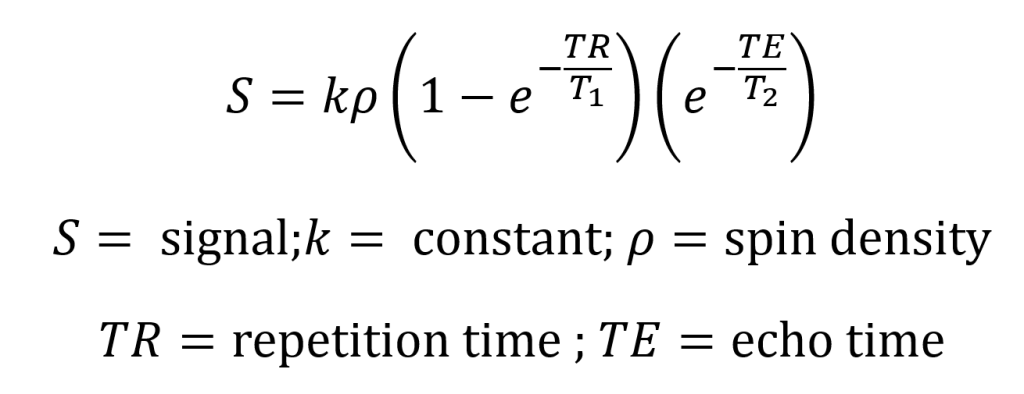
We begin with a simple equation which summarizes most of MRI with just a few variables and ideas that we will need to drag from your high school math.
In this equation, ρ (rho), T1 and T2 are functions of the tissue that you are imaging. The value k is a constant, and TR (repetition time) and TE (echo time) are derived from the sequence parameters. The exponential (e) is natural exponential function. So, despite the mildly complex equation, 3 values are from the tissue that you are trying to measure, 2 are from the MRI sequence and the last one we don’t need to worry about.
We use this equation to try to understand what kind of signal (S) comes from a particular MR sequence, defined by TR & TE. If you look closely, the equation suggests that all MR images contain some level of both spin density, T1 and T2 components. It is for this reason that we refer to MR sequences as spin-density, T1-weighted or T2-weighted when we are being precise, as opposed to simply “T1 or T2 images”.
So, let’s see how this works on the next post.
 Carolina Laboratory for Advanced Radiological Imaging and Technology