Our original equation quietly assumed a 90° pulse — tip all the magnetization into the transverse plane, read it, repeat. But you can tip by any angle α you like, and gradient-echo imaging usually chooses much less than 90°.
Why give up signal on purpose? Because a small flip angle leaves most of the magnetization sitting along the z-axis, where it barely has to recover before the next pulse. That lets you use a very short TR and scan fast. The trade-off is that each readout uses only a slice of the available signal. Putting the general gradient-echo signal on one line:

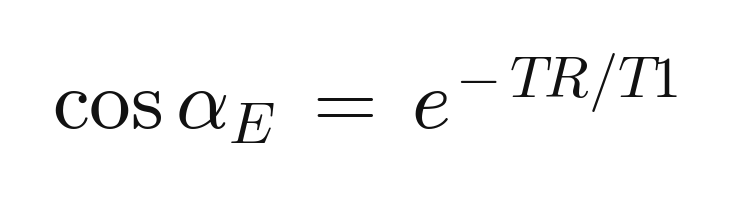
There is clearly a sweet spot: tip too little and there’s not enough transverse signal; tip too much and you flatten the longitudinal magnetization faster than a short TR can restore it. The angle that maximizes signal for a given TR and T1 is the **Ernst angle**:
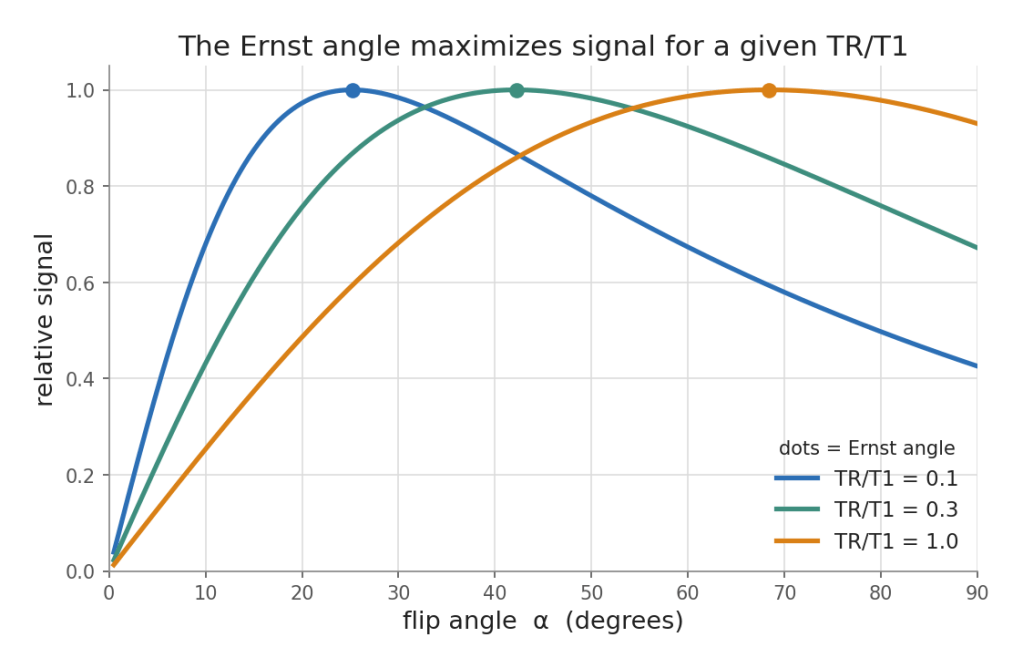
Read the curves left to right: the shorter your TR relative to T1, the smaller the Ernst angle. That matches intuition — if you barely give the tissue time to recover, don’t spend much of it each pulse. It is also why the flip angle on a fast gradient-echo sequence is often a modest 10–30°, not 90°.
Two posts from now we’ll have covered every symbol in the equation and a few beyond it.
 Carolina Laboratory for Advanced Radiological Imaging and Technology