Contrast agents are where all this T1 talk pays off at the workstation. Gadolinium is strongly paramagnetic, and the key idea is simple: it gives nearby water protons a fast new pathway to relax, which shortens their T1 (and, to a lesser degree at usual doses, their T2). As a rate, the effect just adds on:
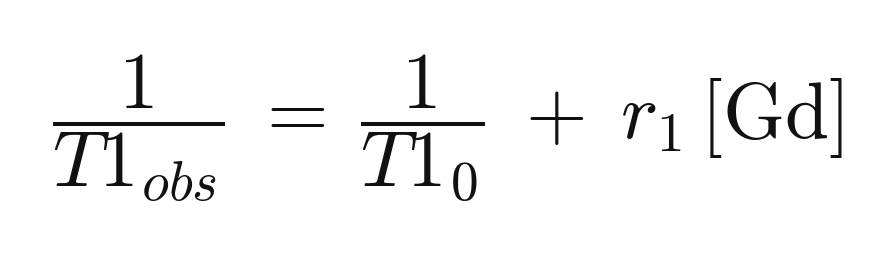
Now feed a shorter T1 back into the T1 term of our signal equation, `(1 − e^(−TR/T1))`. At a fixed TR, making T1 smaller pushes that term up, so the
enhancing tissue gains signal and turns bright on T1-weighted images. Visualize it on the recovery curve: gadolinium slides a tissue’s curve to the left, so at the same TR it sits higher.
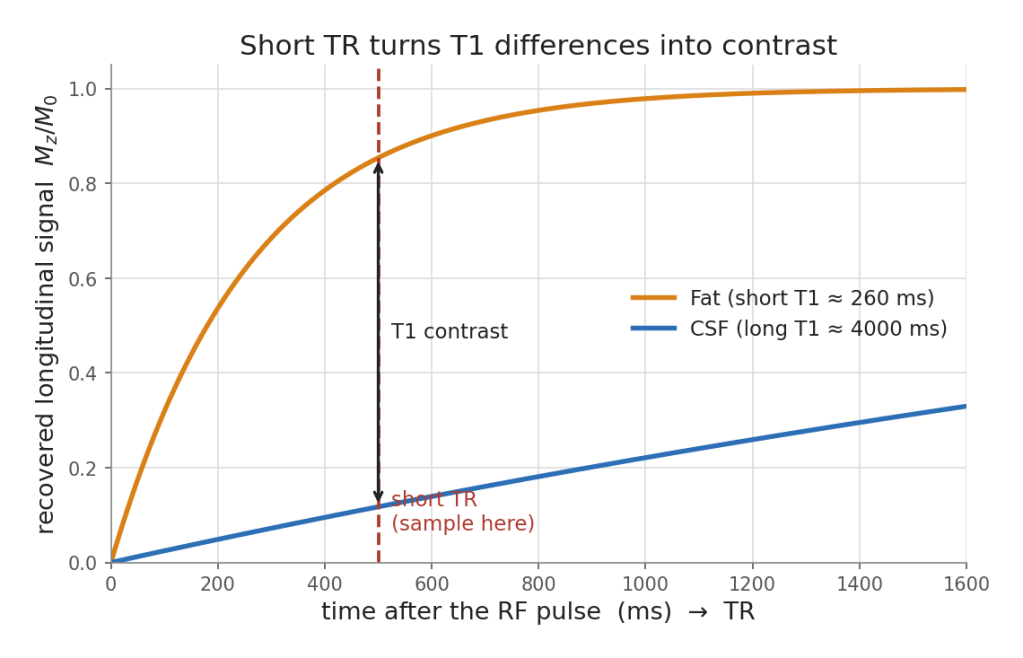
That is the whole reason we image enhancement on T1-weighted sequences: the mechanism *is* T1 shortening.
Two practical notes for the PACS station. First, always compare pre- and post-contrast T1 images — enhancement is a change in brightness, and fat or proteinaceous fluid can be intrinsically bright on the pre-contrast scan and fool you. Second, at high local concentrations (a bladder full of excreted gadolinium, or a tightly packed injection) the T2-shortening effect takes over and you can see paradoxical signal loss instead of brightening. This paradoxical effect drives dynamic susceptibility contrast (DSC) perfusion imaging for the brain.
One last trick and we’ve built a real toolbox: what if we flip the magnetization all the way to negative before we start?
 Carolina Laboratory for Advanced Radiological Imaging and Technology