Here is an inconvenient truth about the `e^(−TE/T2)` term: if you just excite the tissue and watch, the signal fades much faster than the true T2 would predict.
The reason is that the main magnetic field is never perfectly uniform. Protons sitting in slightly different local fields precess at slightly different speeds, so they drift out of phase with each other and their signals cancel. That faster, inhomogeneity-driven decay is called T2* (T2 star), and it always beats true T2:

To rescue the true T2, the spin echo plays a clever trick. Halfway to our echo time, at TE/2, a 180° pulse** flips all the spins. The ones that were racing ahead are now placed behind, the slow ones ahead — and since everyone keeps their same speed, at time TE they all catch back up in phase, producing an echo.
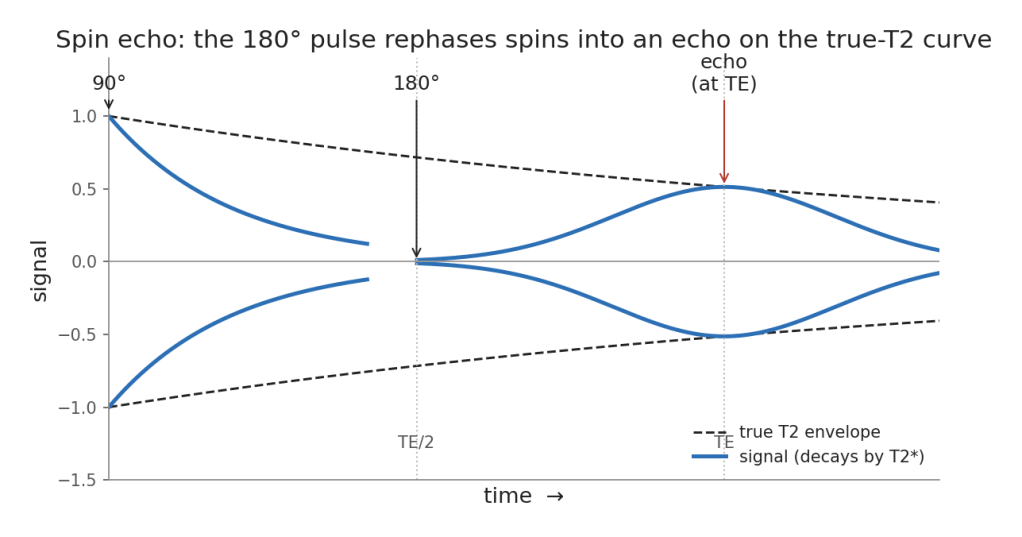
The height of each echo is set by the true T2 (dashed envelope), because the 180° pulse cancels out the fixed field-inhomogeneity part. So the `e^(−TE/T2)` in our equation quietly assumed a spin echo all along.
At your PACS station this distinction has teeth: T2* is what makes blood products, calcium, and air “bloom.” These are caused by local magnetic field differences, or “susceptibility” When you want that sensitivity you *skip* the 180° refocusing pulse.
 Carolina Laboratory for Advanced Radiological Imaging and Technology